
.jpg)
Another British PM closer to Unity
Liz Truss is now the leader of the
Conservative Party and British Prime Minister. No real surprise there.
She is the fourth leader of the Tories in six years. And as each has tried and
failed to reshape Britain to a post Brexit world Tory government policy –
especially under Johnson - has shifted further and further to the right.
If Truss’s rhetoric during the
election contest is to be believed this trend will increase on her watch. The
challenges facing Truss are huge. While some arise from the war in Ukraine most
are a consequence of the Brexit referendum in 2016 and of policies she promoted
while in government.
The devastating impact of Brexit on
the British economy has been enormous. There is a shortage of essential workers
in agriculture, in the health service and elsewhere in the British economy. The
trade deals with non EU countries that Truss has trumpeted as compensating for
Brexit have had little effect. The NHS is unable to meet the demands being
placed upon it. The miles long lorry queues in Kent are evidence of Brexit’s
failure. And there is now the cost of living crisis pushing oil and gas and
food prices up to unimaginable levels and driving many citizens deeper into
poverty.
So far Truss has refused to outline
her policies to meet these challenges. We know that she is for a tougher stance
against refugees and is an advocate of the Rwanda policy of sending them to
Africa. We know that she wants to scrap Britain’s link with the European
Convention on Human Rights – a key element of the Good Friday Agreement. We
know that she for tax cuts that will only benefit the wealthy. In essence we
know that she is from the Boris Johnson mould of incompetent politics and is
set on continuing these.
When it comes to Ireland Truss doesn’t
care. Any more than Johnson did. She has indicated a willingness to back
the DUP demand for unilaterally triggering Article 16 of the Withdrawal
Agreement with the EU. This would see the British breach international law and
suspend those elements of the protocol which they and their unionist allies
don’t like. Earlier this year Truss introduced the “Northern Ireland Protocol Bill” which if passed by the British
Parliament would also allow individual Ministers to scrap the protocol. The
Bill is due in the British Lords after the summer recess.
The EU has
repeatedly claimed that the British have refused to engage in any serious way
in negotiations on the protocol. This approach will continue under Truss as
will the chaos and confusion that has marked successive Conservative
governments for over a decade. The likely consequences of this for the North
and for the island of Ireland and indeed for Scotland, do not look good. But
many people’s eyes will be opened. More and more will realise that British
government policy has always been dictated by what is in the British – English
- interest. Ireland’s interest will never be served by London.
Our response must
be to challenge this at every opportunity. The British government has no
mandate in Ireland. Only the people of our island have the right to govern
ourselves. The sooner the better. No matter what else happens on her watch with
Truss’s selection we are another British PM closer to that day.
ON DANGEROUS GROUND.
This is not a
book review. It is a book recommendation. On Dangerous Ground is a memoir by
Máire Comerford, edited by Hilary Dully, with an introduction by Margaret Ward.
It was recently published by Lilliput. ON DANGEROUS GROUND is required reading
for all aspiring republican revolutionaries and students particularly of the
period from 1916 to the 1920s. From revolution to counter revolution. From the
Proclamation of 1916 to partition and civil war.
Máire became a
republican activist in 1916. She joined Cumann na mBan and Sinn Féin and she
had a full role in many of the events which followed the Rising. She remained
an unrepentant republican up to her death in 1982 and kept up a
keen involvement in the struggle during all this time. Máire befriended Rita O
Hare, Danny Morrison and other activists of our time. Danny gave the oration at
Máire’s funeral. She had hoped to have her memoir published in her life time
and she had deposited a version of this in UCD in the 1970s.
But it was
never published until now. Hilary Dully has done outstanding work editing and
including additional material from Máire’s UCD Archive. It is to her great
credit and the support of her husband Joe Comerford, Máire’s loyal and devoted
nephew, that On Dangerous Ground is published now, almost forty years after her
death. But it is also timely in this The Decade of Centenaries.
This is
because it is a republican activists account of what happened during the
revolutionary phase and then in particular during the period when the Truce was
arranged and the Treaty talks were established in London. The sad slippage into
civil war and the outworkings of the manipulation of some Irish leaders by
London is graphically chronicled. Máire was in the Four Courts when it was
bombarded and later inside the Hamman Hotel when it was burning. She
experienced the counter revolution.
There are many
fascinating aspects to this wonderful book, including Maire’s own back ground
and political development. The footnotes on their own are fascinating. But for
me its strength is in Máire’s understanding of the counter revolution, of
partition and how it was connived. It is also uniquely a rare recording of the
role of a republican woman and her sisters in our struggle. Well done Máire.
And well done Hilary Dully.
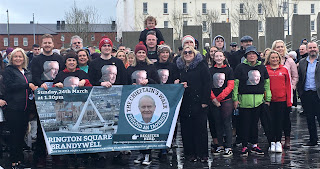
THE CHIEFTAINS WALK.
The Chieftains
Walk will be on Sunday 18th September at 1pm in Derry. It is in memory of
Martin McGuinness. So why not join us and Martin’s family. The walk is
organised by The Martin McGuinness Peace Foundation. The foundation was
established in September 2019, two years after Martin’s death.
The objects of
the Foundation are;
To celebrate
the life and achievements of Martin McGuinness, as a leader, a political
activist and an international statesperson. The Foundation is established for charitable
purposes only and in particular to carry out charitable activities for the
public benefit in the areas of:
• The
advancement of reconciliation, conflict resolution, unity and peace building -
locally, nationally and internationally;
• Community
empowerment;
• The advancement
of human rights, and;
• The
advancement of equality, inclusivity and diversity.
Since its
inception the Foundation has organised a number of events around reconciliation
as well as an online concert marking Martin’s 70th birthday.
The Foundation
also organises annual events which include the Chieftain’s Walk, a Gaelic Games
Blitz and a Fly-Fishing competition. This year the Foundation, in
recognition of Martin’s passion about the importance of education and
employment, has introduced a bursary scheme to help people build better futures
for themselves and their families.
The
Chieftain’s Walk has been disrupted over the last few years due to Covid
restrictions but this year, with restrictions lifted, the Foundation is looking
forward to seeing the return of the hundreds of people who have previously
participated in the Walk joining us as we remember our Chieftain.
The proceeds of the Chieftain’s Walk will go to help support the work of the Foundation and I want to encourage everyone to sign up at www.register.enthuse.com/ps/event/ChieftainsWalk2022
The route of
the Walk will be from Martin’s home, down Westland Street, along Rossville
Street, William Street, Waterloo Place, Guildhall Square, Shipquay Street,
around the Diamond, up Bishop Street and onto the Derry Walls via Stable Lane. The
Walk will then proceed around the Walls in an anti clockwise route, coming off at
Magazine Street, proceed through Butcher Gate and down Fahan Street, and out
through Rossville Street and the Lecky Road to the Long Tower Centre.

Chieftains
Walk New York.
If you live in
New York or you happen to be there on September 18 you can play your part by
joining in the New York Chieftain’s Walk assembling at the Irish Hunger
Memorial in Battery Park City at 10.00am on September 18, 2022.
You may also
want to attend the inaugural Martin McGuinness Peace Foundation Dinner in the
Manhattan Manor on the evening of September 21st. You
will be very welcome. Details are available on the Foundation’s Website and
social media platforms.
admin@martinmcguinnesspeacefoundation.org
Comments