
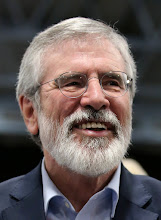

For over two decades October has been designated Breast Cancer Awareness month around the world. The pink ribbon or the wearing of pink has become synonymous with the campaign to raise awareness of this dreadful disease. On Thursday morning Martina Anderson MEP, who was in Dublin for the visit of the European Parliament President Martin Schulz, and I joined other colleagues from the Oireachtas and activists from the Irish Cancer Society outside Leinster House. We were there to add our voices to the efforts of the Irish Cancer Society and Action Breast Cancer, and Action Cancer in the north and many other fine organisations who are involved in raising awareness about breast cancer. I was there also to say thank you for their commitment and dedication.
This year the Irish
Cancer Society has organised a new kind of pink initiative. It’s called ‘Get
the Girls, www.getthegirls.ie
– and its goal is to raise even more money than in previous years for breast
cancer services and research.
Over 4000 new cases of breast cancer are
diagnosed each year across the island
of Ireland Ireland

However it is also true that while the incidence of breast cancer has not dropped the number of women dying as a result has. Early detection and treatment is the key to survival. That means raising awareness among women and men about breast cancer to persuade everyone to check their breasts and to seek help if they have a concern.
Last
week Breast Cancer Ireland
If you have a concern
visit your doctor or go onto the many websites where it’s possible to get
information. For example: www.actioncancer.org, tel nos 02890803344;
and www.cancer.ie,
Freephone 1800200700. Talk to someone. Get the Irish Cancer Society’s
exhaustive directory of cancer support services.
The Irish Cancer
Society and Action Cancer run extensive breast screening services which have
saved many lives. They have also raised significant amounts of money to improve
the outcome for patients and for research. They deserve our full support.
Finally, I cannot write about breast cancer
without writing about my friend and comrade Siobhan O Hanlon. In October 2002 Siobhan was diagnosed with breast
cancer. And for the next three and a half years she battled it every single
day.
Siobhan was a very
private person but in September of the following year, and as part of that
October’s Breast Awareness month she planned and organised a conference on the
issue at the Belfast Institute for Further and Higher Education on the Whiterock Road Belfast
The conference was a
way of bringing community activists and others together to talk about this
issue and to raise awareness. It was also about drawing public attention to the
mobile screening units that Siobhan had successfully lobbied Action Cancer to
bring into west Belfast
So focused was Siobhan
on this issue that for once she set aside her natural reticence to speak
publicly and addressed the audience about her experience.
She told of getting
the news that she had cancer and of the approach taken by the hospitals; of
having her breast removed, and of discovering that the cancer was aggressive.
It was one of the most
moving contributions I have ever heard. I have no shame in saying that I cried
at the end of it. It was typical Siobhan. Honest and frank. She described how
when you have cancer there are a number of big days. And she talked of these.
She included the day
when she lost her hair. At one point she said: ‘I was a mess. I had no hair, no eyebrows. No eye lashes, one breast.
My nails were all broken. I was tired. I knew I had to get my act together. My
hair had stated to grow but it was very slow. It was also terrible grey.’
She described how
there are ‘three terrible days in
relation to your hair.’ They are, she said: ‘1. when your hair starts coming out, 2. when you put a wig on for the
first time, and 3. when you have to take it off again. That was an awful day. I
remember going into the office and this guy was going across the top of the
stairs. He said ‘Ah, Siobhan’. ‘Don't open your mouth’ I told him. ‘I have more
hair than you’. And I did!’
Siobhan died in April
2006. But her courage and determination and example is a constant reminder to
me that whatever can be done to raise awareness about this awful disease must
be done, and whatever help can be given to provide support services for cancer
patients must be given. 

Comments
Breast cancer services and research, in these hard Economic times, very important. The recession makes widespread loss of government fundings and the need to raise even more money. Giving the voice and aspirations to comunities by assisting people to exert political and civil rights cross all political lines. A very important issue, for all concerned.
Seems like you are again being set upon Gerry, sorry to read about people just using Gerry Adams name as some whipping-boy, to blame all problem on. Gerry Adams this and Gerry Adams that, well, usually the name is spelled right, most of the time, even when the fact at not.